ONCE THERE IS A VILLAGE/ UNA VOLTA C’ERA UN VILLAGGIO di MATILDE GATTONI
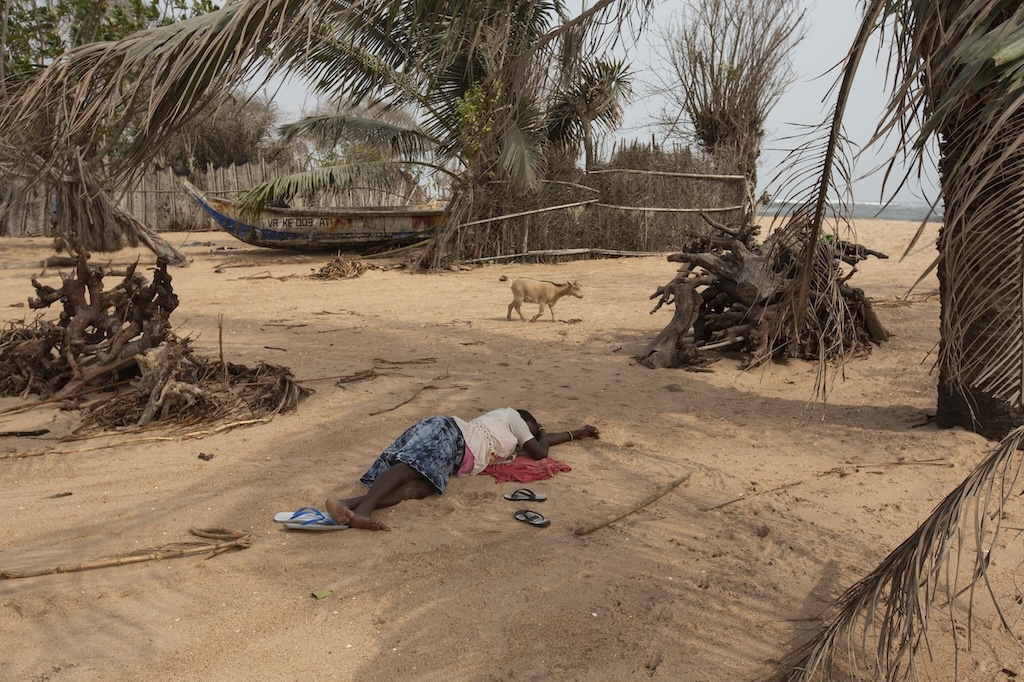
C’era una volta Fuvemeh, un villaggio di pescatori situato su una lingua di sabbia tra l’oceano Atlantico e la foce del Volta.
Per secoli l’acqua vi è stata fonte di vita: l’oceano offriva il pesce, il fiume l’acqua dolce, e ciò che i pescatori traevano dal mare arrivava ben oltre i confini del villaggio, fino a nutrire un intero paese.
Poi il mare ha cominciato ad avanzare. Per vent’anni gli abitanti gli hanno ceduto terreno, smontando le abitazioni per rimontarle più in là, finché alle loro spalle non è rimasto che il fiume.
Sono arrivata a Fuvemeh in un giorno di alta marea. Al mattino il villaggio mi ha accolta all’ombra di un grande albero; nel pomeriggio l’oceano ha invaso le strade e tutti si sono precipitati a smontare le case per salvarne mattoni e lamiere. L’indomani l’albero giaceva sradicato sulla sabbia. Pochi mesi dopo, la terra su cui sorgeva Fuvemeh è scomparsa per sempre sotto l’acqua.
Quando il mare inghiotte un villaggio, non scompaiono soltanto le case, ma un sapere accumulato nei secoli e la memoria di una comunità che non ha altra terra su cui ricominciare. Nate per documentare il presente, queste immagini sono diventate l’archivio di un luogo che non esiste più: una memoria senza terra, che riaffiora, come la riva con la bassa marea, ogni volta che la si guarda.
Once upon a time, there was Fuvemeh, a fishing village situated on a sand spit between the Atlantic Ocean and the mouth of the Volta.
For centuries, water had been its source of life: the ocean provided fish, the river provided fresh water, and what the fishermen brought in from the sea reached far beyond the village’s borders, feeding an entire country.
Then the sea began to advance. For twenty years, the inhabitants ceded ground to it, dismantling their homes to rebuild them further out, until all that remained behind them was the river.
I arrived in Fuvemeh on a day of high tide. In the morning, the village welcomed me in the shade of a large tree; by the afternoon, the ocean had flooded the streets and everyone rushed to dismantle their homes to salvage the bricks and sheet metal. The next day, the tree lay uprooted on the sand. A few months later, the land on which Fuvemeh stood disappeared forever beneath the water.
When the sea swallows up a village, it is not just the houses that disappear, but knowledge accumulated over the centuries and the memory of a community that has no other land on which to start afresh. Created to document the present, these images have become the archive of a place that no longer exists: a memory without a home, which resurfaces, like the shore at low tide, every time one looks at it.
Bio
(Italia, 1974) Fotografa documentarista franco-italiana. Da oltre vent’anni racconta le crisi ambientali, lo sfruttamento delle risorse e i conflitti, seguendo comunità la cui vita dipende dall’acqua e dal legame ancestrale con le loro terre. Negli ultimi anni si è concentrata sulle comunità di pescatori dell’Africa subsahariana. In Ghana, Togo e Benin ha documentato i villaggi inghiottiti dall’innalzamento del mare con il progetto Ocean Rage (2025), arricchito dal nuovo capitolo sul lago Vittoria.
Le sue fotografie sono apparse su The New York Times, TIME, The Guardian, GEO e Der Spiegel.
A Franco-Italian documentary photographer. For over twenty years, she has been documenting environmental crises, the exploitation of resources and conflicts, following communities whose lives depend on water and their ancestral connection to their lands. In recent years, she has focused on fishing communities in sub-Saharan Africa. In Ghana, Togo and Benin, she has documented villages swallowed up by rising sea levels through the Ocean Rage (2025) project, which has been expanded to include a new chapter on Lake Victoria.
Her photographs have appeared in The New York Times, TIME, The Guardian, GEO and Der Spiegel.